Bruce Mau Know How – Make Fact-Based Optimism Your Mantra

The future belongs to those who believe in the beauty of their dreams – Bruce Mau has a way to help you dream smarter

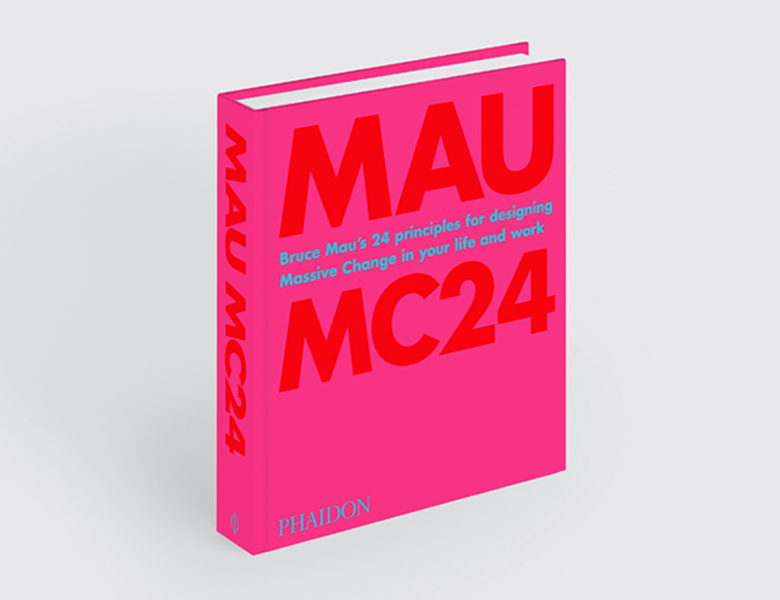
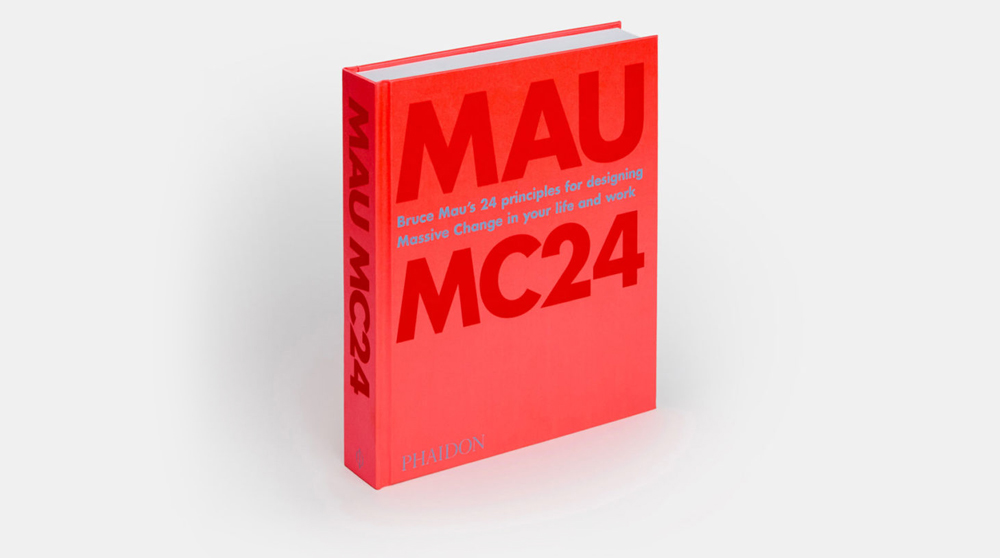
There comes a time in the life of every generation when humanity is called to shift to a new level of consciousness, a time when we have to shed our fear and give hope to each other. We’re very probably at that time right about now. For anyone looking for an emotional and intellectual route map out of the moment might we suggest our forthcoming book, Bruce Mau: MC24.

Why should we care what Bruce Mau says? Well as co-founder and CEO of Massive Change Network (MCN), a Chicago-based global design consultancy he has long applied the power of design to transforming the world. “To undertake the challenges we face today,” he writes in Bruce Mau: MC24, “we have no choice but to be optimistic.” Why? Because, according to Bruce, pessimism lets you off the hook.

“If the world is going to the dogs, there’s nothing you need do but watch, wait, and grab what you can from what’s left of it. Optimism challenges you to action. Wherever there is opportunity, there is work to be done. Possibilities are not actualities. We have to roll up our sleeves to make them real.”

“Pessimism engenders a cynicism that closes the mind: only through optimism does opportunity become visible,” Mau says. But as he points out, fact-based optimism is not the fake cheeriness of a Pollyanna, it is based on looking at things as they are. “But ‘things as they are’ entails a muddled picture of good and bad. It takes effort and discernment to discover which is which. So optimism—even of the fact-based kind—requires mental effort.”

As you’d expect of a man who as well as heading up MCN is also chief design officer of Freeman, one of the world’s largest brand-experience companies, Mau understands analysis is key.

“Optimism without information and analysis is folly. Information and analysis without possibility leads to paralysis. The challenge is to remain informed and thoughtful in the pursuit of the brightest opportunities.

“The global challenges we face today are real and existential. Fact-based optimism makes no pretense otherwise. On the contrary, if we are to avoid disaster we must immediately tackle some of the most vexing problems in human history. To do that, we must start with solid information and then visualize possible solutions, so everyone can join the conversation. Fact-based optimism is a collaborative endeavor.”

For Mau, fact-based optimism may appear unreasonable—but it does not expect to arrive at perfection. Instead, questions are the engine of new thought.

“Generating better questions may be the most important contribution designers can make. But for designers, these questions are never merely academic. Our overriding question is familiar and inescapable: “What is to be done?” The focus of design should always be practical objectives.

“The reality is that we’re living in an age of unprecedented cooperation across the planet. Cooperative activity vastly outweighs conflict. The problem is that cooperation isn’t frightening—and therefore doesn’t compel attention the way conflict does. It’s inherently uneventful.”

Why has cooperation expanded so dramatically? Mau has an answer for that too. “Until recently, problems could only be addressed locally or regionally—it wasn’t realistic to orchestrate a global effort. In fact, it wasn’t possible for the mass of people to “see” the world as a whole. Digital technology has changed that. Now we have vast systems for collecting and organizing data worldwide. Technologies for travel and communications, for example, make international collaboration totally practicable.

“Cooperation, connection, and the creation of global systems for human development are the great untold story of our age. Because of these systems, the present day is the best time in human history to be alive and working.”

You’ll find more fact-based optimism in Bruce Mau: MC24 and look out for more Mau Know How in the coming days and weeks.
 

Bruce Mau Know How – Your 3-Minute Manifesto

We all have an image of a more abundant and equitable world we’d like to live in – Bruce Mau is here to show us how to make it a reality

How many times have you set out on your to do list at the start of a day all guns blazing then slowly despair as ‘important’ gets overtaken by ‘urgent’? Chances are, if you’re deflected and distracted on a daily basis you’re never going to get to plan out the next few years of work and home life. What you need is a Three-Minute Manifesto. Says who? Says Bruce Mau.

Who does Bruce Mau think he is to be telling us all this? Well he’s supremely qualified, for one thing. Mau is chief design officer of Freeman, one of the world’s largest brand-experience companies, and co-founder/CEO of Massive Change Network (MCN), a Chicago-based global design consultancy. He has long applied the power of design to transforming the world. He’s been a visiting scholar at institutions globally, and lectures widely.

One of the things he likes to do is to get people in his orbit to write their Three-Minute Manifesto. He explains why in Bruce Mau: MC24, which contains his 24 principles for designing massive change in your life and work.

“For several years now, I have used a Three-Minute Manifesto exercise in our design workshops,’ he writes. ‘”The instructions are simple: ‘Write down what you want to do with the rest of your life in the next three minutes. Then share it with others.'”

“At first, most people imagine that three minutes is way too short to write a personal Manifesto. Once they begin, however, most participants complete it in less time than that. (In fact, when we first started we allowed six minutes, but most people finished early.) Three minutes is long enough because people know the future they want; they just haven’t been asked.

“What is profoundly inspiring when we all hear the results as each person stands and reads their personal Manifesto, is just how beautiful people are. Almost everyone has an image of a more abundant, equitable, and just world they would like to live in, and of how they would like to help create it. People know how they’d like to apply their talent, energy, and intelligence: they clearly see what role they want to play and the impact they want to have. There is often crying involved in the process. The Three- Minute Manifestos are characteristically optimistic, enlightened, creative, inclusive, and generous.

“People are often astonished by their own Manifestos, and by each other’s: they discover a common commitment to creating a beautiful world. Most powerfully, they discover the hidden beauty that was sitting in the room around them. They had no idea, for instance, that Joe in shipping was a poet who is working to save the planet.”

Maybe you’re Joe in shipping maybe you’re someone entirely different. One thing’s for certain: whoever you are, and wherever you are in life you’ll surely benefit from Mau’s own year’s of experience and generous advice. Look out for our new series of stories from Bruce Mau: MC24 in the coming days and weeks.


Bruce Mau Know How – A Methodology to Inspire Action

Design isn’t just making things look good. Freed from its visual definition it can become a method for leadership

Design has often been confused with making things look good. This is a fundamental error according to Bruce Mau, one of the most saught after designers working in the world today.

Mau believes that if we free design from its visual definition, then it reveals itself to be something quite different: first and foremost, a method for leadership.

After all, to lead, Mau argues, is to envision the future and then systematically work to realize that vision.

It’s hard to dispute that. it’s exactly what designers- at their best- do every day. Leadership and design are both processes of social influence that aim to manifest a vision of what’s possible. Today, there is much talk about leadership as a vague ideal, but little methodology around the subject. Leaders are exhorted to be gritty, determined, empathic, and visionary. All these can be great qualities at the right time and in the right place, but none provide a path of action.

Design, says Mau, in his new book Bruce Mau: MC24 “offers a methodology for leadership that’s both comprehensive and practical. It combines analysis, envisioning, decision-making, prototyping, and continuous learning. It engages all the senses, including our sense of time. It provides a path from rough idea to detailed solution.”

“At its best,” he argues, “design is empathic leadership that should be sensitive to context, including the largest context of all: Planet Earth and its needs.

“We All Have the Power to Inspire, If We Do What It Takes,” he says. “To design is to lead. To lead is to design. To lead through design is to inspire. Human beings are hungry for inspiration. It’s a fundamental desire, perhaps even a biological need. Just as everyone has a need to be inspired, everyone has the power to inspire. But there are requirements that designers must fulfill:

1. Open up to possibilities.

2. Live with purpose and ideals.

3. Constantly measure the work against the purpose and ideals.

He’s right in that people don’t follow mere ideas, at least not for long. They follow exemplary action. “Rhetoric can whip up a crowd and create a momentary high for the individual. But only when words meet deeds can inspiration be sustained for the long haul. All parents learn over time that- for better or worse- it’s what they do that teaches their child, not what they say.

“Everything we do should reflect our declared principles: how we live, how we use resources, how we produce the things we want and need. The formula for leadership by inspiration is challenging but simple: walk your talk. That’s the key to sustained inspiration—and also the meaning of exemplary action. Exemplary action is honest, fresh, insightful and generative. It makes words believable, and visions attainable.

“But we are human. Sometimes we slip up. Sometimes we fail to match our actions to our words. That’s the time for candor. When there’s a discrepancy between ideal and action, we should be open about it and work toward resolving the contradiction. Our human weaknesses can enhance the inspiration we provide, but only if we acknowledge and combat them.

“Finally,” says Mau, “another hallmark of true leadership is generosity: people will be drawn to the leader who gives—or tries to give—the most. Design can be a powerful vehicle for generosity because of its multidimensional character and the rich array of forms it can generate. True designers, like true leaders, care.”

You’ll find more fact-based optimism, leadership know how and really good life learnings in Bruce Mau: MC24 and look out for more Mau Know How in the coming days and weeks.
MC24, Bruce Mau’s New Book, Provides a Roadmap for Radical Optimism

Arriving at an unprecedented moment, the Massive Change founder’s latest offering presents 24 principles for transforming your life, work and world.

It is the worst of times. Bruce Mau’s latest book, MC24 (Phaidon), arrives in the midst of a ravaging global pandemic and an anti-racist movement inspired by the death of George Floyd that has continued for two months now, as the American government has responded by deploying federal agents to violently clash with protesters in some cities. In 2020, the year of an impending U.S. election, the most innocuous and simple life-saving and democracy-upholding solutions – wearing a face mask and voting by mail – are political lightning rods that daily threaten to divide the country.

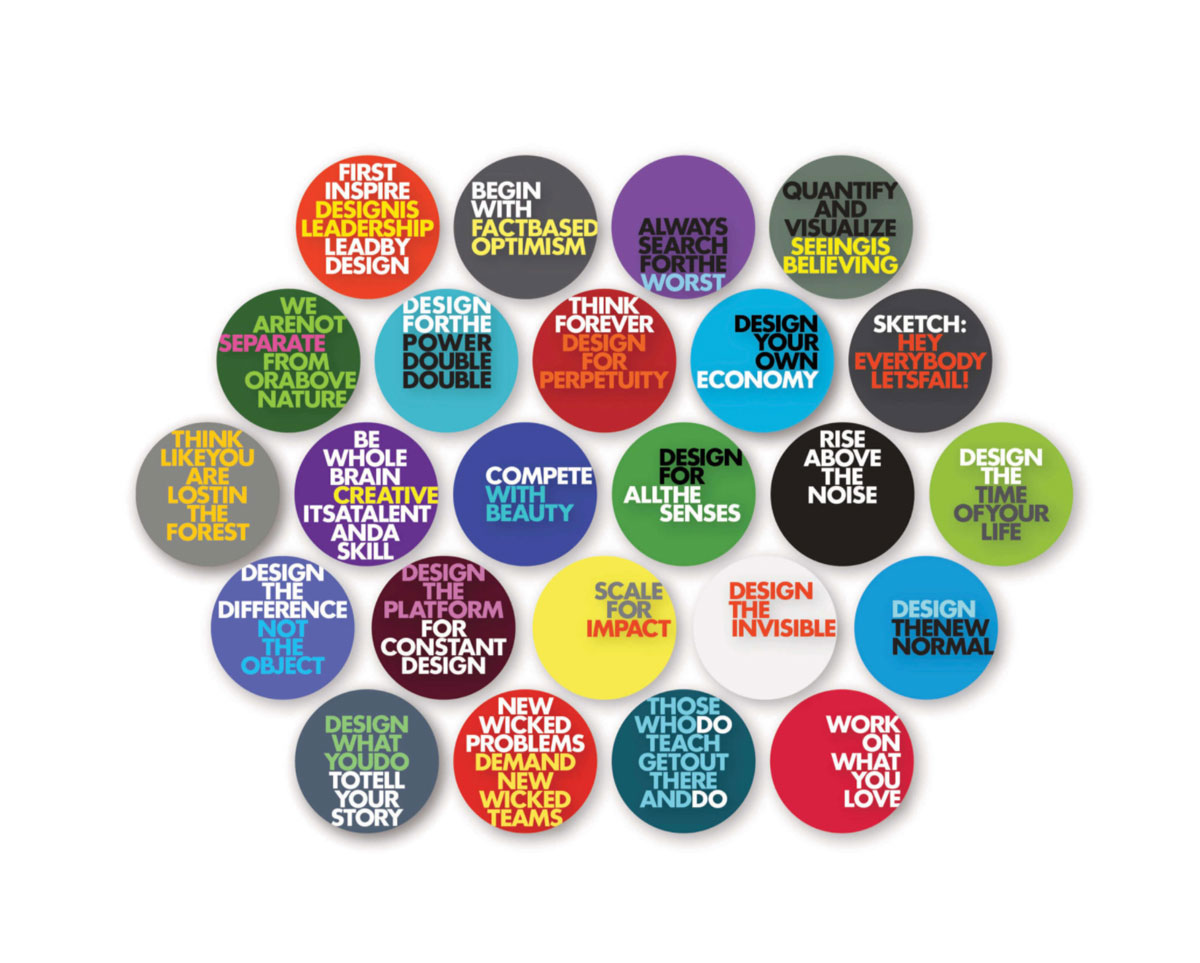
But could it also be the best of times for designers? One of the 24 principles of Massive Change – the name of Mau’s design network and the M and C of the tome’s title – is “Always Search For the Worst.” As Mau writes, “The greater the problem, the worse the crisis, the harsher the experience, the bigger the design opportunity.” He states that practically everything we need to do has to change. And he believes it can.

Mau is a self-described radical optimist. And his two dozen principles ­– each a major mind-set challenge, like “Design Your Own Economy,” accompanied by a discussion on the seemingly impossible realities inherent in such a task and examples of people who have risen to it – attest to his unwavering commitment. Mau has long been a champion of expanding design’s perceived role: He sees doctors and entrepreneurs as designers, whether they define themselves that way or not, when they use innovative thinking and tools to create new, better outcomes. As he told me in a recent interview: “My definition of design is the ability to envision a future and systematically execute the vision.” His book thoughtfully gathers examples of this creative determination, from the novel economic model that Aravind Eye Care System in India instituted in order to treat an overwhelming cohort of poor patients to the empathetic observations that led to inventor Dean Kamen’s stair-climbing wheelchair.

MC24 is the first book that Mau has authored since Massive Change (2004), a companion to the globetrotting blockbuster exhibition, produced with students at the Institute without Boundaries, a program Mau founded at George Brown College in Toronto. The ongoing Massive Change project, which began in the early 2000s and is still active today, catapulted the idea of design’s central role in solving the world’s most challenging problems. It was also transformative for Mau. Prior to it, he had been a highly renowned Toronto-based graphic designer. His creative direction for Zone Books and his collaboration with Rem Koolhaas – on S,M,L,XL, which rewrote the rules on monographs – broke the mould; and his stream-of-consciousness rumination on his own brand’s work, the free-wheeling and often-poetic Lifestyle, also endures as an icon. But Massive Change cemented his reputation as a preeminent thought leader and change maker, a conceptual guru who saw design, or its opposite, design failure, at the heart of everything, from single products to complex infrastructural systems.

Today, Mau is based in Chicago, where he runs the Massive Change Network and serves as Chief Design Officer at Freeman. Over his 30-plus-year career, he has collaborated with megabrands like Coca Cola, on the sustainability platform that involved upcycling PET bottles into Emeco chairs; nations like Denmark and Guatemala, on their legacy-proud but future-oriented branding; and star architects like Frank Gehry, on numerous projects including Panama’s Biomuseo, where Mau designed the mandate and the program, which exemplify the MC principle “We Are Not Separate From or Above Nature.”

The stories of these partnerships are found throughout MC24. Story-telling is, of course, an effective way to unpack process, the motivations inherent in it, and the domino effect of decisions and prototypes made over time in the pursuit of a final result. And Mau is just as enthralled by the journey as the destination. In one of the biographical vignettes he includes, he recalls the experience of getting lost in the woods surrounding his farmhouse in Northern Ontario as a kid in order to explain how, when you’re grasping for clues to your own survival, every detail comes into sharp focus. This terror of the unknown, which recurred for him much later in life, when he and his team were trying to puzzle their way through the Massive Change exhibition, is what designers routinely face if they are doing their jobs right. And he has a principle for that: “Think Like You Are Lost in the Forest.”

Read as a manual for a designer-entrepreneur-thinker-policy-changer, MC24 offers insight for tasks both big and small. A simple exhortation to “Sketch: Hey Everybody Let’s Fail” reminds us that there’s no wrong way to draw, and that unmooring ourselves from our insecurities around our inadequate pencil-wielding skills opens up to us an endlessly agile method of working out ideas. “Compete With Beauty” is a much bigger challenge and argument. Mau advocates for the power of beauty and writes a rhapsodic tribute to his friend, the war photographer Paolo Pellegrin, who still finds beauty in human beings, even after he has seen the worst of humanity. Then there’s the macro-scaled “Design for the Power Double Double.” In the doubling of the earth’s population (which over the past half century has gone from four billion to approaching eight billion), Mau views an opportunity where others might see impending disaster, for the Earth and already-strained regions and societies. The inevitable doubling of humans, he explains, will result in the doubling of ingenuity to address those same social and environmental concerns. This is predicated, of course, on redesigning our education systems to better nurture the latent potential of people around the world.

His book is full of bold, big-hearted vision of this kind. And it’s all good. There’s never been a better time for bringing down the house and building something better in its place. Maybe I’m biased: I worked with Bruce Mau on an exhibition, Prosperity for All, for the 2017 EDIT Festival. But I’m also a skeptic: I’m deeply allergic to the so-called powers of positive thinking. Mau’s book isn’t about that – it’s not about positive thinking, it’s about shifting mind sets towards “fact-based optimism” as a first step towards understanding and approaching the world’s “wickedest” problems. It can be read from the point of view of what an individual can achieve in business, or of what a group of people (Mau champions the shift from Renaissance Person to Renaissance Teams) can bring about on the world scale. In iterating the hidden process behind how he works, and how a number of the people he profoundly admires work ­– and building on the cult-status Incomplete Manifesto for Growth (1998), his earlier attempt at foregrounding the themes that influence his creativity – Mau has laid out the ultimate how-to. I read the book sequentially, but its self-supporting chapters can be referenced individually, again and again.

And maybe, in this moment where time feels as if it’s standing still while people are literally fighting in the streets against the inertia of oppressive, violent, outdated institutions, you will want to – and need to. In balancing his optimistic outlook with real-world examples of transformation, Bruce Mau has offered up a solution to the worst of times – a radically optimistic set of lessons for how we can push ourselves to think differently, and beyond this present moment.


The Creative Fest, Bibiana Ballbe interviews Bruce Mau about MC24

Bruce Mau is a brilliant amalgam of designer, philosopher, curator, author, educator, and visionary 💡. What Bruce does best is provoke, invite, incite, lead, and challenge us to think differently about the world of design and the world of design 🤯. He founded the Institute Without Limits, and that’s where he and his students jointly created the groundbreaking exhibition and best-selling book 👉 Massive Change. His “Incomplete Manifesto for Growth” is a 43-point statement on maintaining a creative life that has been translated into 15 languages ​​📕. He is the author of MC24 and co-founder and CEO of Massive Change Network, a Chicago-based holistic design collective 🌎. He is also the Design Director for Freeman, the pioneers in the live branding experience 🏆.⁠ Find out more about him here!


Why Bruce Mau’s new book is exactly what we need right now

The designer is out to change the world – and he’s just given us the tools to help him do it

If the title of Bruce Mau’s new book MC24 sounds a little bit like a secret formula that’s because it is.

In fact, it’s a formula for success – delivered in the form of a highly-readable manifesto packed with generous advice, tips and galvanizing principles to overhaul the way we think and inspire massive and sustainable change in our lives.

And if you think that sounds like exactly the right kind of book we need right now then we totally agree with you.

As Bruce says in the introduction: “Practically everything we do today needs to change. We are still doing most things as if we own nature and have unlimited resources. We work as if waste is not a problem; we treat our oceans like a pantry and a toilet; we think short term, party like there’s no tomorrow, and pass the check to the future; we dump problems that we can’t solve into places that we can’t see. And many of our solutions create more problems than they correct.”

Who does Bruce Mau think he is to be telling us all this? Well he’s supremely qualified, for one thing. Mau is chief design officer of Freeman, one of the world’s largest brand-experience companies, and co-founder/CEO of Massive Change Network (MCN), a Chicago-based global design consultancy. He has long applied the power of design to transforming the world. He’s been a visiting scholar at institutions globally, and lectures widely.

So yes, pretty smart guy. But, he developed his MC24 principles when he couldn’t answer one very simple question.

“In 2010 I was invited by the Royal Society of Arts in London to be an Honorary Royal Designer for Industry,” he says. “They sent a group of young British design leaders to meet with me in Chicago. I showed them my work. They were baffled. They asked, “What kind of designer are you?” “I’m a designer,” I replied.

“We’ve never seen a designer that does books and cities, carpets and social programs, global brands and cultural institutions. How do you do it?” “I showed you how I do it (irritated). You should have been paying attention.” “No, you showed us what you did, not how you did it. What is your process?” I was stumped. They were right to ask.”

Mau realised that he had organically developed a unique design method over a thirty-year period that had slowly evolved and expanded to being able to solve practically any problem. But he had never written it down. Until now, that is.

“We obviously had a process, not unlike most designers, that starts at a beginning and ends with deliverable results. But that didn’t explain the qualitative differences and the diversity in our work. I realised that there must be principles that informed our work. If I could articulate those principles and provide a way for people to understand and apply them, I could help anyone learn to design in this new way.”

Developed over the past three decades, Mau’s remarkable new book is organized by 24 values that are at the core of his philosophy. Bruce Mau: MC24 features essays, observations, project documentation, and design work by Mau and other high-profile architects, designers, artists, scientists, environmentalists, and thinkers of our time.

It’s designed to give you a new way of thinking— a new approach to creative, social, and environmental impact; a new way of solving problems in your life, your work, or your community.

“Now,” Bruce says, “we can offer this mind-set and tool kit to anyone willing to open their mind and make the effort to apply a new way of thinking and working.”

Design Principles Enable Control. Control equals Success.

This week I spoke to a very special guest, Bruce Mau the Author of a new book called MC24, which relates to Massive Change, and the 24 Principles of Design that Bruce has developed over the past 20+ years. The book, tackles the issues of how to implement these principles in a new way of looking at addressing problems, not only for seasoned designers but it is an essential reference content for entrepreneurs, and business leaders that want to understand the importance of looking to change in this new normal environment. In the interview, Bruce touches on how change can impact the environment, and if designed in the right way gives us the opportunity to help us towards a sustainable planet.

The Design Museum, Tim Marlow + Bruce Mau

Welcome back to another #DesignDispatches. This week we welcome Bruce Mau, Founder of Bruce Mau Studio @realbrucemau, and co-founder and CEO of @massivechangenetwork (MCN), a Chicago-based global design consultancy. Bruce set up his design practice in the early 1980s but sprang to global prominence in the mid-90s when he published the landmark book – S, M, L, XL with Rem Koolhas.


https://www.instagram.com/tv/CCxzimoAraq/?utm_source=ig_web_button_share_sheet